

Real vs Fake Pearls: How to Tell the Difference
November 23, 2026 5 min read
Most people picture real vs fake pearls as a simple split. In practice there are three groups. Jewelers of America lists them as natural, cultured and imitation pearls. Natural and cultured pearls are both real. Only imitation pearls aren't.
That's the part most guides skip, and it's why so many people think their freshwater pearls are fake when they aren't. GIA explains that in a cultured pearl a farmer places a bead or a piece of tissue inside the mollusc, and the animal then coats it in nacre through the same biological process that forms natural pearls.
Some of the popular tests are close to useless, and a few are worth doing properly. Here's which is which.
The three kinds of pearl
Natural pearls form with no human help. GIA says this happens only rarely, and that most natural pearls are small and irregular. It also says the vast majority of pearls on the market today are cultured unless they're specifically described as natural.
Cultured pearls are real pearls grown with a farmer's help. Freshwater, akoya, Tahitian and South Sea pearls are all cultured types. Our own jewellery at Akuna Pearls is built around freshwater cultured pearls, and you can read how they're grown in our post on how freshwater pearls are farmed.
Imitation pearls aren't pearls at all. Jewelers of America says they have no connection to the natural pearl-making process. They're usually glass, plastic or shell beads with a pearly coating.
The rub test
Rub two pearls gently against each other, or drag one lightly across the edge of a front tooth. Jewelers of America says cultured pearls feel gritty because of their layers of nacre, while imitations glide. Clean pearls first, and ask before testing anyone else's. Treat it as a first check only, because some imitation coatings are textured.
Surface
GIA says most pearls have small surface features such as spots, bumps or wrinkles. Imitations are often suspiciously perfect. There's a catch, though. Modern bead-nucleated freshwater pearls can grow very round, so one flawless pearl doesn't prove anything. A whole strand where every pearl is identical in size, colour and lustre is more suspicious.
Lustre
Real pearls have depth. Light moves through the layers of nacre, which is why good pearls show soft overtones and sometimes a rainbow shimmer called orient. A coated bead tends to look like flat, glossy paint. Tilt the pearl under daylight and watch how the shine behaves.
Drill holes
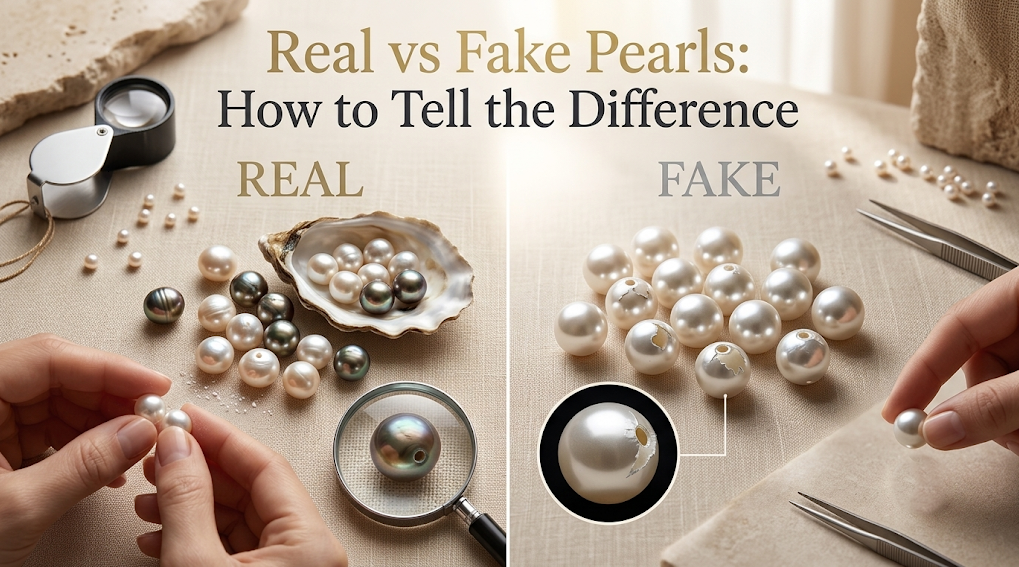
Look closely at the hole. On genuine pearls the nacre usually carries on around the opening. On imitations the coating may chip and show a different material underneath. One note of caution: GIA says very thin nacre on a cultured pearl can let the bead show through, so a visible bead isn't automatically a fake. Paint flaking off glass is a different thing.
Tests that mislead
Weight is the classic example. Real pearls often feel heavier than plastic, but GIA notes that large soufflé freshwater pearls are typically lightweight, and glass imitations can feel heavy.
Temperature has the same problem. Real pearls feel cool at first touch, but so does glass.
Then there are the destructive tests: acid, a flame or a pin. Don't. They can ruin a real pearl and prove very little.
A two-minute routine
If you only have a minute or two, work in this order. Read the listing or ask the seller what type of pearl it is. Rub two pearls together. Check the drill hole in good light. Then look at the lustre. If most of those point the same way, you've probably got your answer for everyday purposes.
What real freshwater pearls look like
Real pearls aren't always white and round. GIA says freshwater pearls commonly come in pastel shades such as pink, peach, yellow and lavender, and that baroque pearls have irregular, free-form shapes that form naturally during growth. Odd colours and shapes are signs of a real pearl, not a fake one.
At the other end, Edison pearls are bead-nucleated freshwater pearls that GIA says can reach 11 to 16 millimetres or more, with strong lustre and consistently round shapes. They look polished, and they're real. That's why we'd rather you judge a pearl on several features than on whether it looks perfect. You can see the variety in our pearl necklaces and pearl bracelets.
Real vs fake pearls at a glance
|
Check |
Real pearls tend to show |
Imitations tend to show |
How reliable |
|---|---|---|---|
|
Rub test |
Slight grit |
Smooth glide |
Good first check |
|
Surface |
Small natural marks |
Uniform, unmarked |
Moderate |
|
Lustre |
Depth, overtones |
Flat gloss |
Good with practice |
|
Drill hole |
Continuous nacre |
Chipped coating |
Good |
|
Weight |
Varies by type |
Varies by material |
Poor |
|
Temperature |
Cool at first |
Glass is cool too |
Poor |
Cheap doesn't mean fake
GIA says freshwater pearls are known for their friendly price point, partly because freshwater mussels can produce multiple pearls at once. So a $30 pair of freshwater studs can be perfectly genuine.
What should raise an eyebrow is a low price attached to a big claim, such as "natural South Sea" or "Japanese akoya". GIA also calls the term "freshwater akoya" misleading, because those pearls aren't akoya. Read the listing, and if it doesn't say what type of pearl you're getting, ask.
When a lab report is worth it
A GIA Pearl Identification Report states whether a pearl is natural or cultured and whether it formed in freshwater or saltwater. A separate classification report grades quality, and for cultured saltwater pearls a combined report also notes whether the pearl has been treated.
For everyday cultured jewellery, you rarely need one. For an inherited strand, an estate piece, or anything sold as natural, it's worth the cost, because that's where the value gap between natural and cultured gets large.
If you've been sold a fake
In Australia, the ACCC says it's illegal to mislead or deceive customers or make false representations. If a seller called something a cultured pearl and it's glass or plastic, keep the receipt and the original listing, then raise it with the seller. If that goes nowhere, your state or territory consumer affairs office is the next stop. That's general information, not legal advice.
Which check for which situation
-
Buying new from a shop or website: make sure the listing names the pearl type, such as freshwater cultured, and that the seller answers questions plainly.
-
Inherited or antique pearls: get a lab report before you insure or sell them.
-
Found in an op shop or at a market: do the rub test and inspect the drill holes, then take them to a jeweller if they pass.
-
Buying a gift: ask the seller what the pearls are, and keep the paperwork.
Frequently asked questions
How can you tell if a pearl is real?
Use several checks together: the rub test, the surface, the lustre and the drill holes. Skip weight and temperature, which mislead. If a lot of money is involved, a lab report is the only definitive answer.
Are freshwater pearls real pearls?
Yes. Freshwater pearls are cultured pearls made of real nacre, grown in freshwater mussels. GIA calls them one of the most widely available and affordable pearl types. See our freshwater pearl earrings for examples.
What's the difference between cultured and natural pearls?
Both are real. A natural pearl forms with no human help. A cultured pearl starts with a farmer placing a bead or tissue in the mollusc, then forms in the same way.
Can fake pearls feel gritty?
Sometimes. Some imitation coatings are textured, which is why the rub test is a first check and not a verdict. Look at the drill holes and the lustre as well.
Do real pearls peel?
Real nacre doesn't peel like paint. But thin nacre on a cultured pearl can wear over time and let the bead show, which is why nacre quality matters. Flaking around the drill hole usually points to a coating on an imitation. Our guide to cleaning pearl necklaces at home shows how to look after real nacre.
Subscribe
Sign up to get the latest on sales, new releases and more …
